I have lived for many years now in a small farming village in
The central
My mother would never ever go back to this town of her birth. The painting captured a memory of happy youth in
My so
n Seth has made four trips to
I had not planned to revisit my grandparents’ Heimat. For me, 
With my son’s encouragement and support (although he was unaware of that), I steeled myself to conquer my inner landscape, letting go of the turmoil and rage. Seth
and I bought air tickets to
But, there was also a personal story that needed resolution. A family secret had haunted me and needed to be laid to rest at the cemetery in Vacha. I would be going as an “emotional tourist” visiting the site of a family tragedy, fulfilling a promise, and doing the work of teshuvah for my family.
The first part of the pilgrimage was to Herborn, a bustling town about 45
minutes outside of
Their homes on the Austrasse shared a common garden which
extended the length of the block and was behind the Sternberg stables and butcher shop.
The photo below shows the shop attached to the home and a portrait of the family with friends. From the right rear is my great grandmother Josefina Rosenthal, her son-in-law Heinrich Sternberg, his wife, my grandmother Emma. In the front row are their children. From the right is Leo, Betti, my mother, and Bernhard.
My mother studied piano at the conservatory in
What I learned on this trip from Johanna’s daughters was the extent of this friendship. During the 1930s the Meckels had hidden food in the backyard garden so that my grandparents could survive. Had this cache been discovered the Meckels would have been imprisoned by the Nazis. On this trip, I made sure to visit their graves and offer a prayer of thanks to them.
Johanna married Paul Schnittert, a lawyer. He tried to avoid the military but was eventually conscripted and sent to serve in
Seth has continued this family friendship of over 100 years into the next generation.
In Herborn the town archivist showed me sites where Jews had lived and the plaque where the synagogue once stood. They also discovered and restored a mikvah. It was the “extinct people tour.” This is a town with no Jews. They fled to foreign lands or vanished on transports to their deaths.
Seth and I walked to the Jewish cemetery and cleaned the mos
s off the stones and said prayers. The cemetery was well maintained and had not been damaged during the Nazi period because it bordered on a Psychiatric Hospital and a Christian cemetery.
Vacha had been a border town in
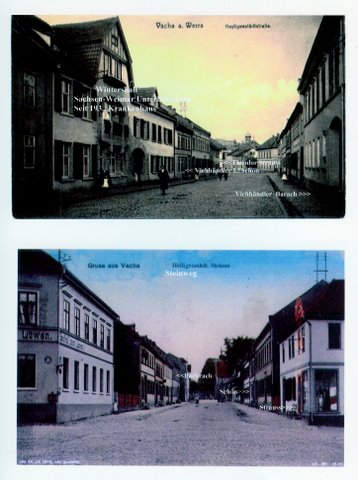
family had visited. It is a beautiful village that time has forgotten. I felt as if I was back in the 1920s and admire the strength of my grandparents—maintaining their Orthodox Jewish life in this little German village. Kaufmann and Therese Schon were part of a community of 20 Jewish families. They lived on Steinwegstrasse (1915 views on right).
They were also cattle dealers just like my other grandparents, as the bill of
sale on the left proves. Herr Georg Hess and his wife from Wolferbutt are paying off the cost of a cow purchased on Nov. 5, 1934. It seems that Kaufmann Schon was also a shochet as the document on the right from the provincial Rabbi Dr. M. Cahn from Fulda reveals.
My grandparent’s home had been taken over and combined with the small
hospital next door during the 1940s or so. With the reunification of
Just as in Herborn, I went on tour of the town and was shown where the Jews used to live and the synagogue used to stand and curiously a restored mikvah. It was haunting and I felt like an American Indian visiting former grounds where ancestors had worshipped. There were no more Jews in this village. Only signs and memorials and a room in the local museum.
Since at least the 18th Century the Schons lived in nearby Volkershausen. Kaufmann’s father was Isaak and his mother was Hanna. They had five children pictured here: Rosalie, Kaufmann (far right), Veilchen (front center), Louis, and Ida. Kaufmann was the one to move to Vacha in the early 1900’s.
My father Isaak left to come to
My grandparents Kaufmann and Therese did not want to leave her behind when they finally left
Growing up in the German Jewish shtetl of
I was resolved to transform the family secret and shame into an acceptable reconciliation a belated Jewish burial of sorts. I have been saying kaddish for her for many years and in 1986 I gave her name to my daughter. But,
Seth and I drove up to the cemetery on a hill overlooking Vacha—
a very bucolic tranquil spot. The cemetery had been repaired some years ago through the financial contribution of a distant cousin Louis Schoen. In order not to invite renewed vandalism, it was decided to leave the stones leaning on their bases rather than put them upright again. A few local residents, Inge Wimmer, an historian, Gunter Hermes, the head of the
In the cemetery I located the grave of Kaufmann’s twin sister Veilchen. It
was broken in half. Next to the gravestone I placed a small smooth round stone with the name Selma Schon written on it and her date of birth. Her stone would be next to her aunt Veilchen.
On behalf of my entire family, I spoke out loud to
I felt a heavy weight leave me. I had also found some peace.
Together with Seth I had spied out the land and the people that had terrified my family and I was no longer afraid. I found myself at ease. Two generations had passed and the profaned land is transforming itself. The newest generation has a full awareness of the crimes of the grandparents.![]()
It is this generation that Seth is making friends with. Together, I hope they will work to make this world a better place.
This journey was inspired by the work of the Jewish Historical Society of Western Massachusetts and was made possible through the generosity of The Harold Grinspoon Foundation Incentive Grant.
My thanks to my wife Jane Trigere for her encouragement and design help.

Thank you so much for your poignant tale. I, too, share the Herborn experience though through a somewhat different lens. My trip to Herborn in 1976 was joyous, thanks in large part to the kindness of Johanna Schnittert and her family, with whom I stayed for several days. I was treated with much love as I walked the streets of the town and visited with the older shopkeepers. I was welcomed as the granddaughter of Max and Ida Sternberg, and the many stories shared by the town folk gave new meaning to the lives of Oma and Opa, my father Fred and Aunt Bette, who – of course — married your Uncle Bernhard. I do think it is important to retrace the steps our parents and grandparents walked before the journey that led them to the United States. I’m delighted you found the courage to do so and were rewarded with greater peace and serenity. Much love…
Sandi
Very moving story. Ken and Seth were very courageous. We are not sure we could have done the same thing in Poland and Lithuania. We felt as if we were reviewing the history of an entire people through the description of the trip.